// allow IE to recognize HTMl5 elements
if (!document.createElementNS) {
  document.createElement('article');
  document.createElement('aside');
  document.createElement('footer');
  document.createElement('header');
  document.createElement('nav');
  document.createElement('time');
}
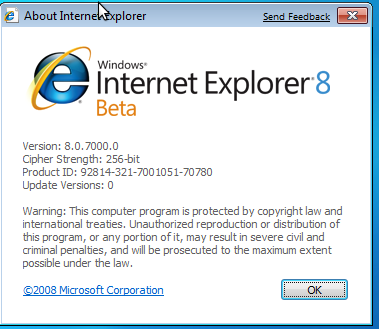
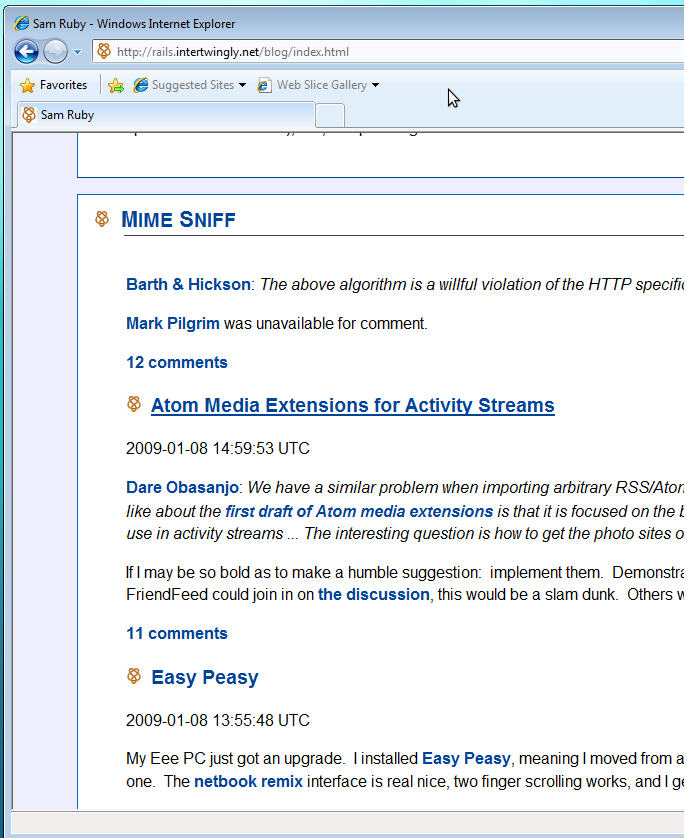
Result. Renders considerably better than any previous beta or released version of IE. The nav bar and data dropdowns aren’t repositioned because IE8 doesn’t implement document.addEventListener("DOMContentLoaded", ...), which I can work-around if I chose to. Scrolling further down the page reveals a different problem...
Looking at the DOM, you can see the issue: after the first two articles, subsequent articles are nested. Note that the svg element appears to be processed into a single node without the need for Sjoerd’s workaround. I’m presuming that that is a result of IE8’s so-called Improved Namespace Support.
But I said “appears” above. If I expand the svg node, I can see the individual path elements. But if I go back to my source and remove those path lines from the HTML, the enclosing article will close correctly; the error simply moves down to the next article.
Windows 7 is available for download for testing purposes only. It can be made to work under VirtualBox OSE though getting network, sound, and Guest Additions requires some additional steps.
Dare Obasanjo: We have a similar problem when importing arbitrary RSS/Atom feeds onto a user’s profile in Windows Live ... What I like about the first draft of Atom media extensions is that it is focused on the basic case of syndicating audio, video and image for use in activity streams ... The interesting question is how to get the photo sites out there to adopt consistent standards in this space?
If I may be so bold as to make a humble suggestion: implement them. Demonstrate the value. If WindowsLive, YouTube, and FriendFeed could join in on the discussion, this would be a slam dunk. Others would quickly follow.
My Eee PC just got an upgrade. I installed Easy Peasy, meaning I moved from an Xandros based distribution to an Ubuntu based one. The netbook remix interface is real nice, two finger scrolling works, and I get Firefox 3. Performance even seems snappier.
Video, wifi, suspend/resume all work fine, sound required a slight adjustment.
Jon Udell: If we recapitulate the RSS/Atom experience with ICS, and lots more ad-hoc ICS feeds arrive on the scene, charts like this will go even redder. To make them go green, we’ll need a more robust ICS validator.
Jon has done an excellent first step: demonstrating that there is a problem.
Larry Masinter: “When the C++ committee (ISO/IEC JTC1/SC22/WG21) produces a document, are they producing a Technical Specification of the language, or an Applicability Statement on compiler implementation?”
I don’t yet fully know what I can accomplish as co-chair of the HTML working group, but I do intend to approach every raised issue with a disarmingly simple question: Is this something you intend to work on?
A few highlights of this edition (as compared to the second edition) are as follows: installation completely updated, static scaffolding (don’t laugh, this completely broke the previous edition’s approach to the Depot application), a balanced focus on REST and non-REST interfaces, atom_feed helper, Internationalization, timestamped migrations, ActiveResource, and Passenger. And a bazillion or so smaller changes. A few things left for the next edition: JQuery, Metal, Merb, and Ruby 1.9.
Yesterday, a new micro-framework named Metal has been introduced which allows one to intercept requests, whether it be for performance reasons or simply to call out to another framework. Sinatra has already been demonstrated, Merb can’t be far behind.